How Chicago Christian School is Getting Students Off Their Phones at Lunch
Photos provided by Chicago Christian School
Walk into the lunchroom at Chicago Christian High School these days, and you might notice something different.
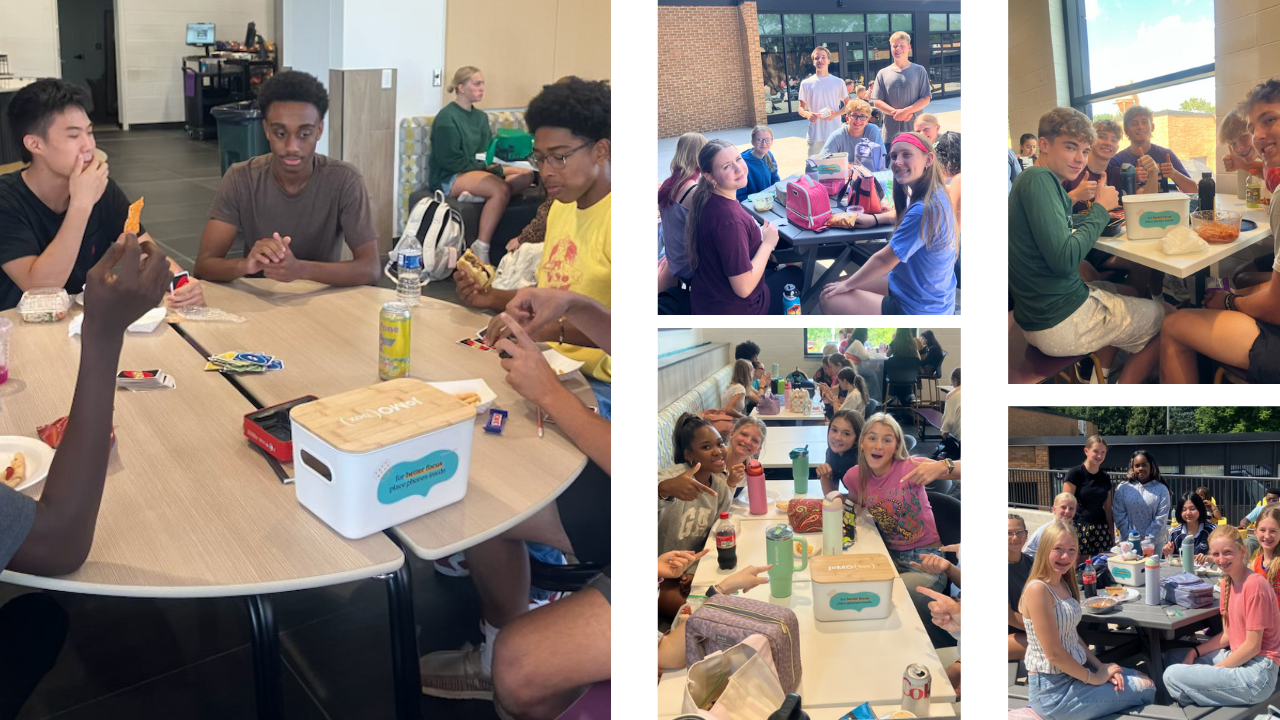
At one table, a group of senior boys is playing UNO. At another, students are talking over lunch with their phones tucked away. Around the room, there is a little more conversation and, as Principal Mike Drury describes it, more “buzz.”
It’s the kind of starting shift that Chicago Christian hoped to see when the school began asking a bigger question about technology: How can we help students develop a healthy, balanced relationship with their devices while protecting the spaces that help community flourish?
What Happens Outside the Phone-Free Zone?
When Chicago Christian partnered with JOMO, school leaders were looking for support navigating digital well-being from a distinctly Christian perspective, including how to approach their cell phone policy.
Rather than implementing a full bell-to-bell ban, the school chose what Mike describes as an “80/20” approach. During class time and chapel, phones are put away. Students have more freedom to use them during breaks and lunch.
The approach gave students some independence while creating clear boundaries around learning. But it also revealed something.
During those breaks, almost everyone was on a phone.
Instead of talking, laughing, playing or simply spending time together, students were often absorbed in their phones.
For Mike and his team, the answer wasn't another restriction. They wanted to help students experience an alternative—to rediscover the community already available to them around the lunch table.
Listen to Chicago Christian’s full story in this brief video.
Senior Boys are Leading the Charge
The idea is simple.
Students who want to participate place their phones in a JOMO box at their lunch table and grab a game to play together. If the whole table participates, each student receives a punch on their JOMO card. Fill all ten spaces, and the completed card goes into a prize draw.
Participation is completely voluntary. And only a few weeks into the school year, half of the lunch tables are already taking part.
One of the biggest surprises? The students leading the charge.
“Our senior boys have really taken a big charge in this.” Mike says. “They have packed lunch tables, and they're dedicated. Every single lunch, they're using it [the JOMO box].”
That group of senior boys have made playing UNO together a regular part of their lunch hour.
When Phones Aren’t the Only Option
The goal isn't really to get students to fill punch cards. It's to help them experience what happens when the phone is no longer the automatic choice. A conversation starts. Someone pulls out a game. Students laugh together. The lunchroom gets a little louder.
The school is helping students learn the importance of choice in building healthy digital habits. The vision is that, over time, choosing a social game and talking with each other becomes a habit.
Digital formation isn't about teaching young people that phones are bad or that screen time needs to be reduced. It's about helping them recognize what technology can sometimes displace, and giving them opportunities to practise choosing something better.
At Chicago Christian, that “something better” is often sitting right across the lunch table.
Protecting Sacred Spaces
The JOMO boxes are creating opportunities for bigger conversations.
Mike describes classrooms and chapel as “sacred spaces” within the school. Places where the school has intentionally decided that phones don't belong.
Lunch looks different. Rather than simply removing devices, the school is using the space to help students practice making choices for themselves.
That makes the lunchroom initiative a natural conversation starter. Why might we choose to put our phones away here? Why do we protect certain spaces from digital distraction? What do our technology habits make possible, and what might they get in the way of?
Chicago Christian is intentionally keeping those conversations open with students. Mike has even talked during chapel about the reality that the school's approach to technology will continue to evolve as technology itself changes.
And increasingly, that conversation extends beyond phones.
As artificial intelligence and other emerging technologies become part of students' everyday lives, schools will face new questions about where technology belongs, where it doesn't, and how students can learn to use it wisely.
For Chicago Christian, the lunchroom is one small place to begin practicing making those choices.
What Comes After the Phone Policy?

Chicago Christian's experience points to a question many schools are wrestling with right now: What comes after the phone policy?
As smartphones, social media, AI and other technologies continue to evolve, schools also need to consider how they are forming students to navigate a digital world with wisdom.
That's the conversation we'll be exploring in our upcoming free webinar for Christian school leaders and educators:
Beyond Phone Policies: Forming Students for a Digital Future
September 22, 2026 | 12:30 p.m. ET | 25 minutes
Join JOMO(campus) founder Christina Crook for a practical conversation about moving beyond reactive technology policies toward a more intentional approach to digital formation—one that helps students build Christ-like character, habits, and wisdom they need for whatever technology comes next.